
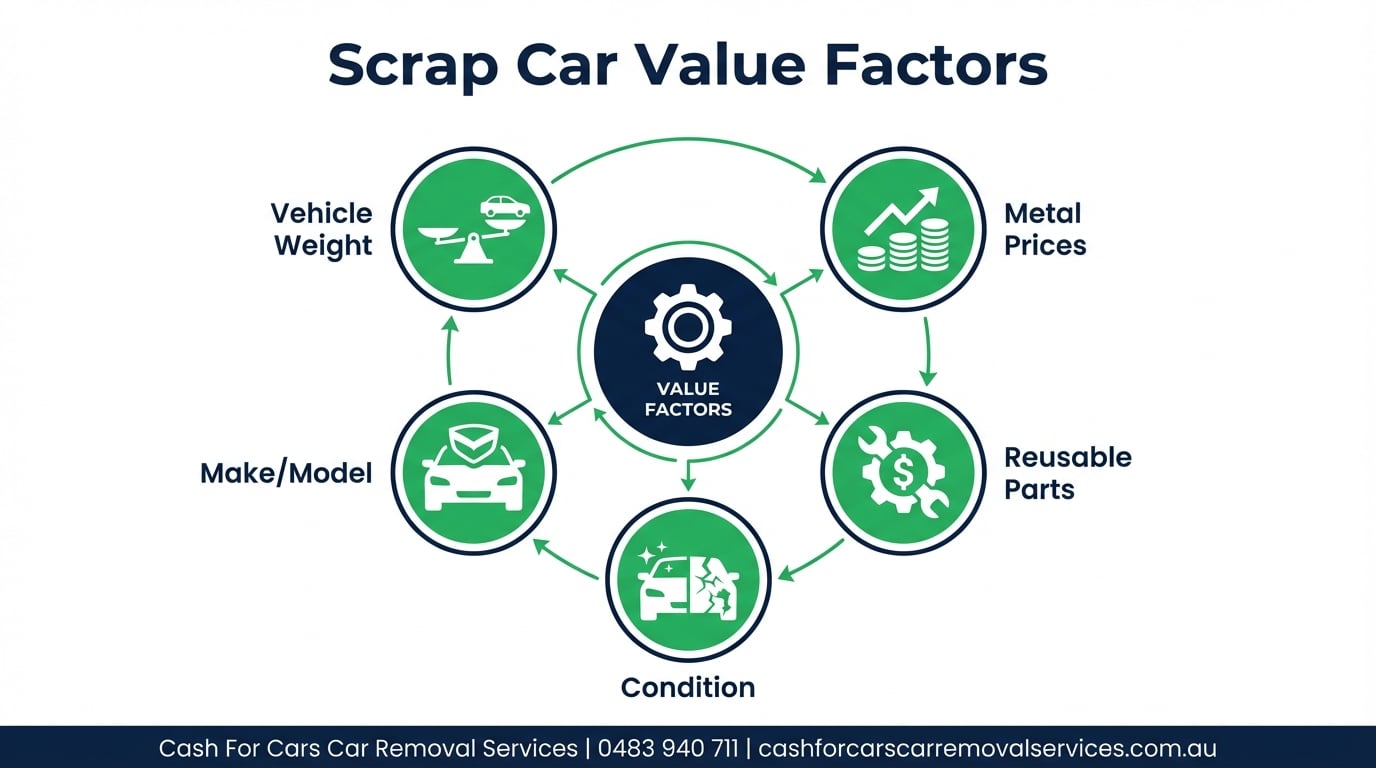
The Science Behind Car Valuations
Whether you're selling to a dealer, private buyer, or cash-for-cars service, understanding how vehicles are valued gives you negotiating power and realistic expectations.
The Three Main Valuation Types
1. Retail Value
What dealers sell vehicles for- Highest price point
- Includes dealer margin and reconditioning
- Assumes excellent presentation
- Warranty often included
- 15-25% below retail typically
- Accounts for reconditioning costs
- Quick and convenient
- No selling effort required
- Between retail and trade-in
- Requires your time and effort
- More negotiation involved
- Payment and safety considerations
- Based on parts + scrap value
- Quick, certain payment
- No preparation needed
- Any condition accepted
- Toyota, Mazda, Subaru: premium retention
- Korean brands: improved perception
- European luxury: higher depreciation
- Discontinued brands: variable
- Popular models = higher demand = better prices
- Niche vehicles = limited buyer pool
- Performance variants often hold value
- 5-15% to vehicle value
- Buyer confidence
- Evidence of maintenance
- Potential warranty coverage
- Raises red flags
- Assumes worst case maintenance
- Reduces offers significantly
- Engine performance
- Transmission smoothness
- Suspension condition
- Brake wear
- Known mechanical issues
- Rust presence
- Panel damage
- Paint condition
- Hail damage
- Previous repairs (quality)
- Seat wear
- Dashboard condition
- Trim integrity
- Odours
- Electronics functionality
- Post-COVID supply shortages increased prices
- New car availability affects used prices
- Seasonal variations exist
- Economic conditions matter
- High fuel = small cars in demand
- Low fuel = SUVs and utes popular
- Currently registered = higher value
- Recently expired = minor impact
- Long expired = significant reduction
- Never registered = specialist valuation
- Current certificate adds value
- Known fails reduce offers
- Make, model, year
- Current condition
- Location for pickup
- Salvageable components
- Demand for parts
- Quality of parts
- Ease of removal
- Current metal prices
- Vehicle weight
- Metal composition
- For vehicles we resell
- Repair cost assessment
- Market demand
- Transport costs
- Processing costs
- Environmental compliance
- Markets (domestic vs export)
- Specialisations (parts vs scrap)
- Overhead costs
- Profit margins
- Know your car's specifications
- Check service history availability
- Note any known issues
- Research similar sales
- Basic clean (interior and exterior)
- Remove personal items
- Ensure all keys available
- Find registration papers
- Undisclosed issues discovered later reduce trust
- Accurate descriptions = accurate quotes
- Surprises at pickup can lower final payment
- Detailed information helps
- "Some rust" vs "surface rust on both rear wheel arches"
- "Engine problem" vs "engine light on, codes show oxygen sensor"
- Total received (payment minus any fees)
- Convenience factor
- Time to payment
- Reliability of buyer
- Won't quote until they see the car
- Want significant deposits
- Pressure immediate decisions
- Don't provide documentation
- Offer significantly above market
- Quote over phone based on description
- Honor quoted prices
- Provide proper receipts
- Complete paperwork correctly
- Pay immediately
- Honest assessment over the phone
- Price guaranteed at pickup
- Free removal from anywhere
- Instant payment up to $30,000
- All conditions accepted
2. Trade-In Value
What dealers offer for your car3. Private Sale Value
What private buyers payCash-for-Cars Value
What removal services offerKey Factors in Vehicle Valuation
1. Make, Model, and Year
Brand impact:
Model desirability:
2. Kilometres (Mileage)
The kilometre sweet spots:
| Odometer Range | Impact on Value |
|---|---|
| Under 50,000 km | Minimal depreciation |
| 50,000-100,000 km | Standard depreciation |
| 100,000-150,000 km | Moderate reduction |
| 150,000-200,000 km | Significant reduction |
| Over 200,000 km | Major impact |
3. Service History
Complete service history adds:
No service history:
4. Condition Assessment
Mechanical condition (50% of assessment):
Body condition (30% of assessment):
Interior condition (20% of assessment):
5. Current Market Conditions
Supply and demand:
Fuel prices:
6. Registration and Compliance
Registration status:
Roadworthy/safety certificate:
How Cash-for-Cars Services Value Vehicles
Our Assessment Approach
Step 1: Basic Information
Step 2: Value Components
We calculate based on:
Parts Value:
Scrap Metal Value:
Reconditioning Potential:
Step 3: Operational Costs
Why Quotes Can Vary
Different buyers have different:
That's why getting multiple quotes matters.
How to Maximise Your Valuation
Before Getting Quotes
Gather information:
Quick improvements:
During Valuation
Be honest:
Be specific:
Comparing Offers
Consider:
Red Flags When Selling
Avoid buyers who:
Professional buyers:
Get Your Fair Valuation
Cash For Cars Car Removal Services provides transparent valuations based on current market conditions.
What we offer:
Call 0483 940 711 for your obligation-free quote!